Hiring a licensed, experienced liquid waste removal firm is one of the simplest ways for Brisbane businesses and property managers to stay compliant, protect the environment, and avoid costly fines or operational downtime.
In this 2026 guide, we’ll cover what liquid waste contractors actually do, the services you should expect, how to verify compliance and documentation, what drives pricing, and a practical checklist you can use to compare providers with confidence.
What liquid waste management and liquid waste disposal firms do (and what “liquid waste” includes)
“Liquid waste” is a broad category.
In practice, a contractor may be collecting anything from routine grease trap waste through to industrial oily water and sludge that needs controlled handling and disposal.
Common liquid waste streams in Brisbane
- Grease trap waste from restaurants, cafés, clubs, shopping centres, and commercial kitchens
- Septic and sewerage waste from septic tanks, pump wells, and onsite wastewater systems
- Oily water and oily wastewater from workshops, transport depots, wash bays, and industrial sites
- Industrial washwater and process water from manufacturing and production environments
- Sludge (higher solids liquid waste) from pits, interceptors, and treatment systems
- Leachate from waste handling areas and certain civil/construction applications
Typical services you should expect
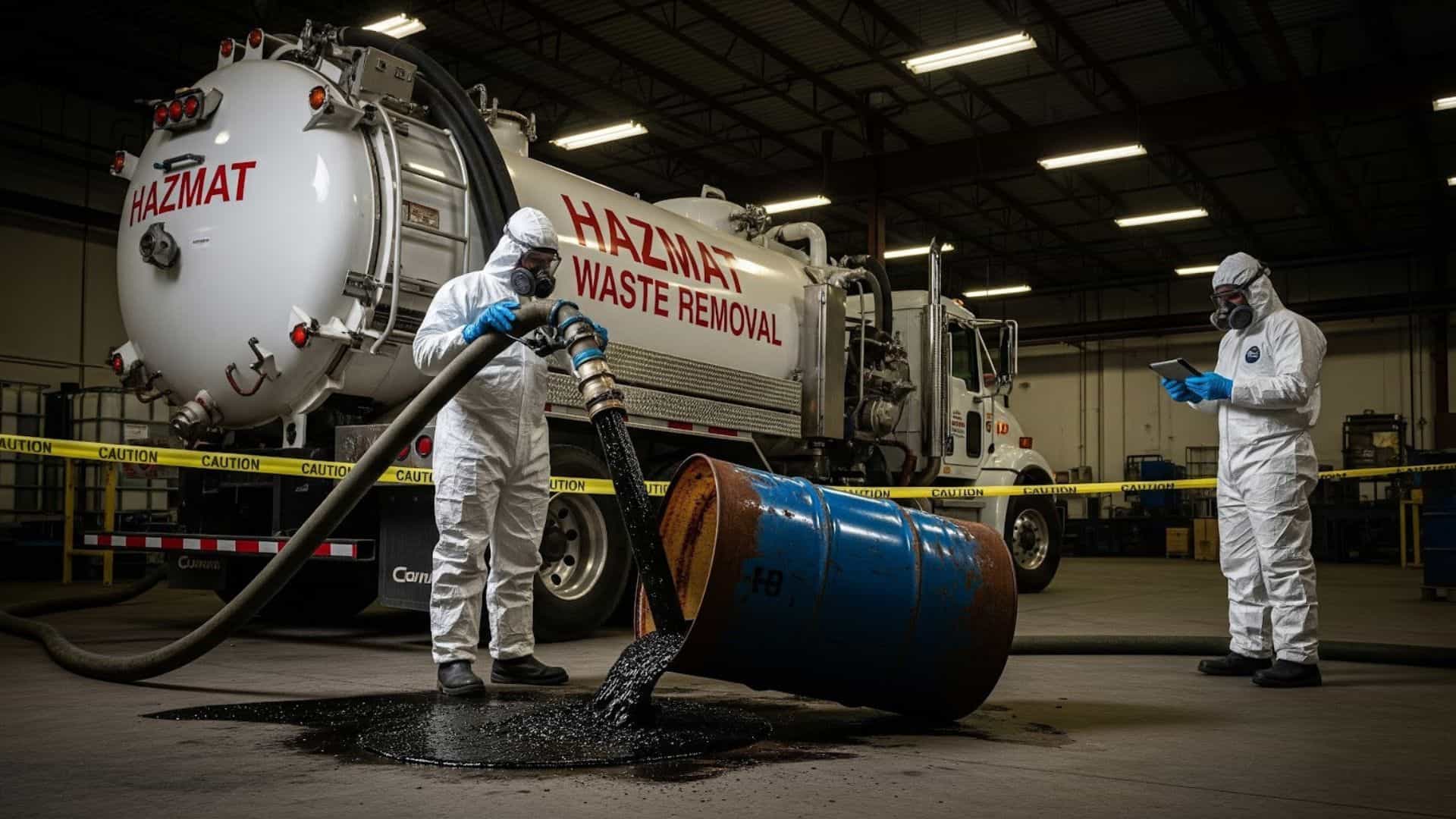
- Collection and transport using vacuum trucks and tankers suited to the waste type
- Pump outs for grease traps, septic tanks, holding tanks, pits, and interceptors
- Cleaning services such as trap/interceptor cleaning and certain tank cleaning scopes (site dependent)
- Emergency spill response support for unplanned liquid releases (where the provider offers this capability)
- Treatment and resource recovery pathways (where appropriate), such as reclaiming used oils
- Compliance documentation including disposal dockets / Waste Transfer Certificates and chain of custody style records
Who typically needs liquid waste removal in South East Queensland
Liquid waste removal is not just an “industrial” service. A good portion of Brisbane’s liquid waste work is routine, scheduled maintenance that prevents blockages, odour complaints, equipment failure, and compliance issues.
- Hospitality venues (grease trap pump outs and preventative servicing)
- Industrial and manufacturing sites (oily water, process water, sludges)
- Construction and civil sites (pits, sediment laden water, certain holding tank requirements)
- Property and facilities managers (multi site scheduled servicing and reporting)
- Local councils (asset maintenance programs and compliance reporting needs)
- Homeowners and rural properties on septic systems (routine pump outs as required)
Before you hire: a practical compliance and capability checklist
When comparing liquid waste removal providers, the most significant risk is selecting a contractor who is capable of pumping the waste but cannot provide evidence of compliant transport or lawful disposal.
Relying on vague promises can leave your business liable for environmental breaches.
To qualify vendors effectively, you should consider the following areas of performance and accountability.
1) Verify licences and permits (Queensland specific)
It is vital to request formal evidence of relevant Queensland environmental approvals and permissions that apply specifically to your waste stream.
You must confirm that the company is legally authorised to transport the exact type of waste your facility generates, particularly if the material is classified as hazardous.
For internal procurement records, ensure you request documented licence details for your vendor files.
If a provider appears hesitant or claims they have never been asked for such documentation, this should be viewed as a significant warning sign regarding their compliance standards.
2) Confirm they handle your exact waste stream
Liquid waste management is not a universal service; a firm that specialises in grease traps may lack the equipment or permits required for oily wastewater, heavy sludges, or high risk chemical streams.
To avoid issues, provide the contractor with a comprehensive description of the waste, including its source, likely contaminants, approximate volume, and the required frequency of collection.
You should also clarify whether the waste will be handled as hazardous or non hazardous, as this changes the requirements for containment and disposal.
Sharing previous disposal dockets or laboratory results is highly recommended, as it allows the contractor to scope the job accurately and provide a precise quote.
3) Check equipment, access, and capacity
The physical requirements of the job must match the provider’s fleet and expertise.
You should verify that the vacuum tanker’s size and configuration are appropriate for your waste volumes and site access limitations.
If your waste is particularly thick or sludge like, ensure the provider has high solids capability to prevent blockages or incomplete pump outs.
Furthermore, confirm they carry adequate containment and spill control equipment for safe transfers and have a clear site access plan.
This plan should account for height restrictions, confined space access, loading zone requirements, and any needs for out of hours servicing.
4) Ask where the waste will go (treatment, disposal, recovery)
A reputable provider must be able to explain, at a high level, the process for treating or disposing of your waste.
They should also be able to identify if any resource recovery options are available, such as used oil reclamation.
If a contractor provides vague or evasive answers regarding the destination of the waste, it often indicates a lack of proper environmental controls or the use of unauthorised disposal points.
5) Require traceable documentation for audits
To protect your business during an audit, you must confirm that you will receive formal disposal dockets or Waste Transfer Certificates for every load.
Ask the provider how these records are stored and how quickly they can be retrieved if you require historical reporting.
For those managing multiple sites, it is beneficial to request consolidated reporting and a consistent docket format across all locations to simplify your administrative processes.
6) Confirm insurance and safety systems
Before work commences, verify that the provider holds valid public liability insurance and, depending on your risk profile, pollution liability insurance.
You should also request evidence of their documented Health, Safety, Environment, and Quality (HSEQ) procedures.
Ensure that the technicians attending your site are fully trained and equipped with the correct Personal Protective Equipment (PPE) for the specific hazards of the job.
7) Check references and local experience
Experience within the local landscape is invaluable. Ask for recent examples of similar projects completed in Brisbane and South East Queensland.
Local knowledge is particularly important for sites within industrial hubs such as Rocklea, Hemmant, Acacia Ridge, and the TradeCoast.
In these areas, specific site access challenges, traffic windows, and localized compliance expectations can vary significantly, and a provider familiar with the region will be better equipped to manage these variables.
Essential questions to ask (copy/paste for calls or an RFP)
- Licensing & insurance: “Can you provide evidence of current Queensland environmental approvals relevant to this waste stream and your current insurances?”
- Waste capability: “Can you manage and dispose of [your waste type]? How do you classify it, and what handling controls do you use?”
- Disposal pathway: “Where is the waste treated or finalised? Can you explain the process at a high level?”
- Documentation: “What documentation will you provide after each service (disposal dockets / Waste Transfer Certificates), and how quickly?”
- Response times: “What are your typical lead times for scheduled services, and do you offer same day or after hours support if needed?”
- Preventative servicing: “Do you offer regular service contracts (for example, scheduled grease trap cleaning)? What frequency do you recommend for our site?”
- Site safety: “What pre start checks and risk controls do your operators follow on site?”
Pricing in 2026: what drives liquid waste removal costs in Brisbane
Pricing is commonly structured as a per service fee, per litre/per load rate, per truck arrangement, or a scheduled contract rate. The right question to ask is not “what’s the cheapest pump out?” but “what is the total cost to complete the job compliantly, with documentation, and without surprises?”
Common cost drivers
- Waste type and classification (hazardous or higher risk streams often cost more due to controls and disposal requirements)
- Volume and solids content (high solids loads can take longer and require different equipment)
- Access constraints (tight access, traffic management needs, or restricted service windows)
- Frequency (scheduled servicing can reduce emergency callouts and improve cost predictability)
- Disposal and levy components (treatment/disposal fees and any applicable charges)
- After hours work (if you need minimal disruption to operations)
Hidden charges to clarify upfront
- Travel and call out fees
- Surcharges for high solids or difficult pump outs
- Additional fees for hazardous classification controls
- After hours rates
- Documentation and reporting inclusions (or extras)
Red flags: when to walk away
- No proof of licence or insurance when requested
- Vague disposal answers (for example, “we take it to a place” without naming lawful pathways)
- No documentation offered or an inability to provide disposal dockets / Waste Transfer Certificates
- Very low bids that exclude safety controls, containment, and reporting
- No emergency capability (if your site risk profile requires it) or inadequate spill control approach
How to compare quotes quickly (simple scoring matrix)
If you’re assessing two to five providers, use a weighted score so compliance and traceability don’t get overshadowed by price.
- Compliance & licences: 25 points
- Waste type capability & equipment: 20 points
- Documentation & tracking: 15 points
- Response times & availability: 15 points
- Pricing transparency & total cost: 15 points
- References & local experience: 10 points
Tip: Keep a notes column for “evidence provided” (licence docs, sample dockets, insurance certificates). It makes vendor review far easier later.
Sample vendor email request (editable)
Subject: Quote request – liquid waste removal service (Brisbane)
Hi [Provider name],
We require a quote for quarterly grease trap pump outs (3 traps, ~500 L each) at [site address] in Brisbane.
Please confirm:
- Your relevant Queensland licence/approvals for this waste stream (and evidence)
- Where the waste will be treated/disposed of (high level pathway)
- Response times for scheduled services and urgent requests
- Documentation included (disposal dockets / Waste Transfer Certificates)
- Total annual cost and what’s included (travel, disposal fees, levies, after hours rates)
Thanks,
[Your name]
[Company]
[Phone]
Why many Brisbane sites choose Lee’s Environmental for liquid waste and complex waste streams
Lee’s Environmental supports Brisbane and South East Queensland customers with practical, compliance led waste solutions.
If your site generates anything from routine grease trap waste to more complex liquid waste streams, the key is having a partner that prioritises safety, clear documentation, and reliable scheduling.
- Safety first service delivery with job specific controls and trained operators
- Compliance and traceability to support audits and internal reporting
- Capability across complex waste problems, including hazardous waste services (where applicable)
- Responsive support for urgent issues and operational downtime risks
If you need help scoping your waste streams or tightening up documentation for compliance, Lee’s Environmental can assist with a site based review.
Book a free waste audit via Lee’s Environmental.com.au.
FAQ: liquid waste removal in Brisbane
How often should grease traps be pumped out?
It depends on trap size, kitchen volume, and what you’re producing. Many commercial kitchens operate on a scheduled cycle (often monthly to quarterly). A contractor can recommend a frequency based on your site and help prevent blockages, odours, and compliance issues.
What documentation should I receive after a pump out?
You should receive a disposal docket or Waste Transfer Certificate (or equivalent documentation) that records the collection and disposal pathway. Keep these on file for compliance and audit purposes.
Can we pump out liquid waste ourselves?
For commercial and industrial contexts, liquid waste handling and transport can introduce safety and environmental risks. Use a licensed provider with the right equipment, approvals, and disposal pathways rather than attempting ad hoc handling.
Do liquid waste contractors offer emergency help for spills?
Some do. If spill risk is part of your site profile (workshops, depots, industrial plants), ask about after hours response, containment equipment, and escalation processes. Spill? Call Lee’s Environmental’s 24/7 emergency team.
Next step: shortlist providers and request evidence early
The best liquid waste removal firm is the one that can prove compliance, match your waste stream with the right equipment, and provide clear documentation every time.
Use the checklist and scoring matrix above, request evidence early, and prioritise reliability over the lowest headline price.
Need a compliant, reliable liquid waste removal partner in Brisbane? Request a quote or book a free waste audit at Lee’s Environmental.