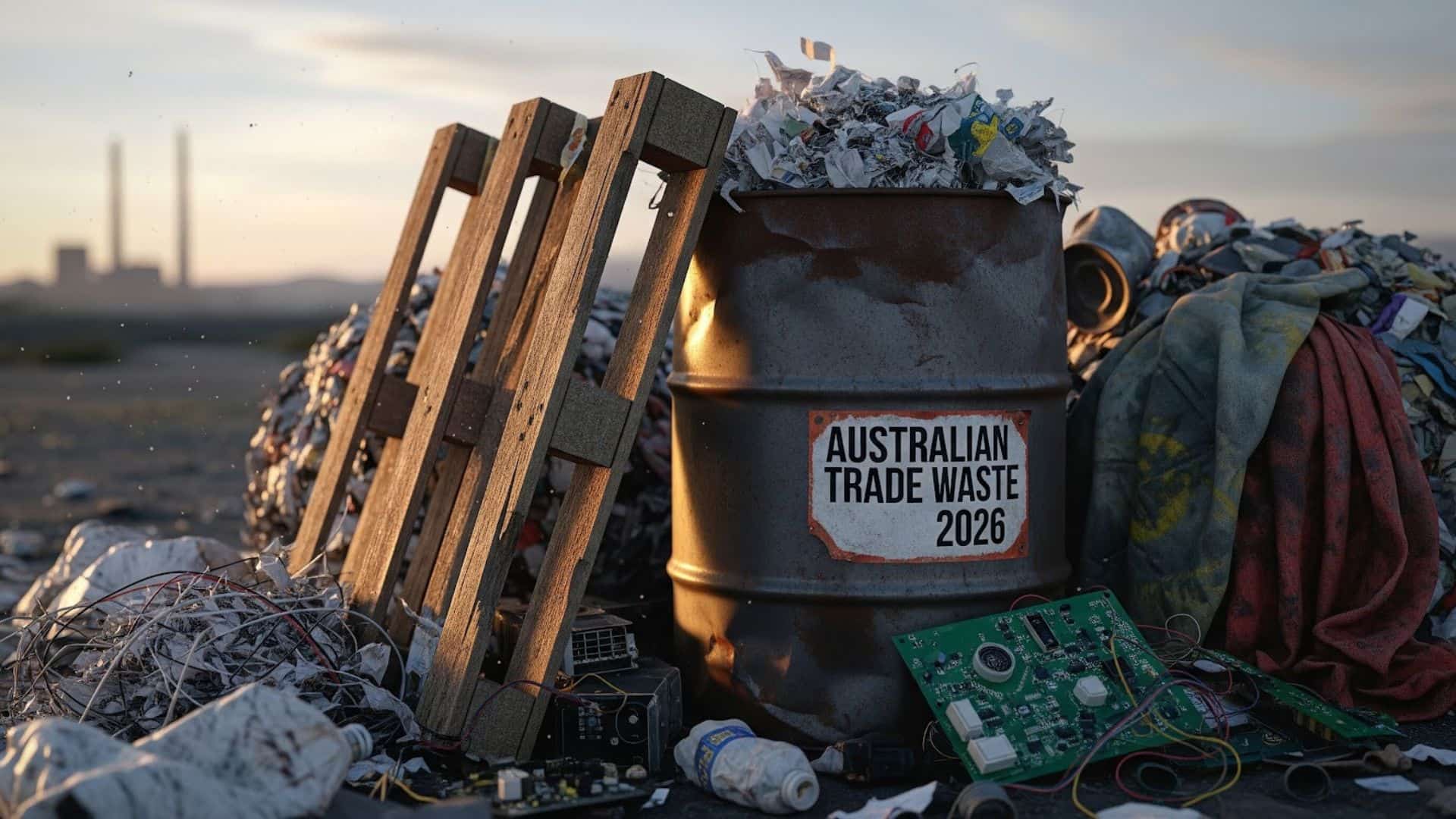
Trade waste in Australia is changing quickly as it seeks to constantly align with the best environmental solutions.
Between national packaging deadlines, tighter landfill diversion targets, and rapid improvements in sorting and reporting technology, 2026 will reward businesses that treat waste as a managed operational risk (and a recoverable resource), not just a cost line.
In this article, we’ll break down the most important trends shaping the Australian trade waste industry for 2026, what they mean for industrial and commercial sites, and the practical steps facilities and EHS teams can take now to stay compliant and cost effective.
What “trade waste” means in 2026 (and why it’s under the spotlight)
Trade waste generally includes waste generated by commercial, industrial, construction, and civil activities. In practice, that can include:
- Construction and demolition (C&D) materials (concrete, timber, metals, soils)
- Commercial streams (cardboard, plastics, general waste, food organics)
- Industrial by products (process residues, packaging, contaminated materials)
- Regulated and hazardous wastes (solvents, oils, chemicals, contaminated absorbents)
Why the spotlight? Australia is pushing higher resource recovery rates and lower landfill reliance through policy, procurement requirements, and growing ESG expectations. The result is a trade waste environment where traceability, segregation, reporting, and recovery outcomes matter more than they did even a few years ago.
Insight 1: Circular economy expectations become “business as usual” with 2026 packaging targets
For those generating trade waste, this shift results in heightened scrutiny regarding the materials brought onto a site, the waste leaving it, and the viability of recovering those materials at the end of their lifespan.
This regulatory landscape necessitates higher expectations for source separation, particularly for cardboard, organics, and soft plastics.
Furthermore, procurement strategies must now prioritise packaging formats and products with recycled content, while reporting requirements have expanded to satisfy internal ESG targets and the supply chain demands of customers.
To prepare for these changes, businesses should begin by mapping their packaging waste to identify the highest volumes and most significant contamination risks.
It is also essential to combat “wish cycling”—the practice of tossing non recyclable items into recycling bins—by redesigning collection methods through better bin placement, clearer signage, or the use of balers.
Finally, when dealing with waste partners, you should explicitly request recovery documentation that tracks the journey of key waste streams to ensure your business remains audit ready.
Insight 2: Smart tech and AI will reshape how trade waste is measured, sorted, and verified
By 2026, “smart waste” has transitioned from a niche concept to an industry standard.
T’he integration of IoT sensors, optimised routing, and AI driven sorting systems is actively reducing contamination and improving recovery rates while providing more credible reporting data.
This technology offers real time visibility into bin fill levels, which helps prevent unnecessary collections and overflow incidents.
Moreover, advanced sorting at facilities means that poorly segregated loads are more likely to be identified, providing the precise data needed to support rigorous ESG and compliance reporting.
For high volume sites such as manufacturing hubs or large scale retail centres, the focus should be on establishing data ready fundamentals.
This involves standardising bin types and waste streams across the entire site to prevent confusion between different shifts or contractors.
Systems should be designed to encourage correct disposal habits through consistent colours and placing bins exactly where waste is generated.
Success in this area should be measured against specific KPIs, including landfill diversion rates and monthly recovery statistics for each individual waste stream.
Insight 3: Waste to energy (WTE) expands for non recyclables, but needs careful governance
As the pressure to divert waste from landfill intensifies, Waste to Energy solutions—such as recovering energy from non recyclable residuals or producing biogas from organics—are becoming increasingly relevant.
However, trade waste generators must view WTE not as a catch all green solution, but as a specific tier within a hierarchy that still prioritises waste reduction and traditional recycling.
WTE is most appropriate for residual streams that are too contaminated for economic recycling, organic waste that poses a methane risk in landfills, or operations facing regional landfill capacity challenges.
Before adopting WTE pathways, it is crucial to interrogate your waste partner regarding their specific requirements.
And you should always clarify what types of feedstock are accepted, what levels of contamination lead to load rejection, and how the chain of custody is documented.
It is also vital to understand the reporting formats you will receive and to establish a robust contingency plan for instances where a facility is offline.
For any regulated or hazardous materials, always ensure you are using appropriately licensed specialists rather than attempting to manage the process internally.
Insight 4: Specialised recycling will keep growing (organics, e waste, and harder to recover materials)
Trade waste management is becoming increasingly granular, moving away from simple “general waste vs recycling” models toward targeted programs for specific materials.
Organics, including food waste, represent a major growth area where improved processing can significantly reduce both landfill volumes and odour issues.
Similarly, the rapid turnover of commercial devices has made secure, auditable e waste collection essential for both resource recovery and data security.
There is also a growing need for controlled disposal pathways for industrial residues and contaminated consumables, which require more stringent documentation.
The benefit of a specialised approach is clearly seen in multi tenant facilities where different businesses produce vastly different waste profiles.
While a single mixed system often leads to high contamination and increased costs, implementing distinct segregation and scheduled pickups for specific materials like oily rags or cardboard reduces incidents.
This tailored strategy not only improves recovery rates but also simplifies the process of compliance reporting during official audits.
Insight 5: Regional and sector specific strategies will matter more than ever
The trade waste market in Australia is highly localised, with infrastructure availability and state specific regulations heavily influencing what is cost effective.
Recovery options that are viable in one region may be unavailable in another, meaning a “one size fits all” approach is rarely successful.
This is particularly evident in the construction and demolition (C&D) sector, where there are rising requirements to divert materials and use recycled content products.
Additionally, government and large enterprise procurement processes are increasingly demanding evidence of responsible waste management from their suppliers.
To manage multiple sites effectively, businesses should establish a core waste standard—covering bin streams, signage, and reporting frequency—and then adapt that standard to fit local infrastructure.
Centralising governance through a single reporting format allows for easier comparison between sites and helps identify areas for improvement.
It is also wise to build flexibility into collection contracts, allowing the service to evolve alongside changing facilities and regional regulations.
Insight 6: ESG and Scope 3 expectations will push better data, not just better intentions
By 2026, the demand for transparent waste outcomes has become a central pillar of corporate sustainability reporting.
Organisations are now expected to provide consistent data using the same methodologies month to month, ensuring full traceability for high risk or regulated streams.
This places the onus on waste partners to provide timely, auditable reports that can withstand external scrutiny.
Improving your waste reporting can be achieved through several quick wins, such as clearly defining your waste categories—ranging from commingled recycling to hazardous materials.
Establishing a monthly review process to address contamination hotspots or bin placement issues ensures continuous improvement.
Furthermore, it is essential to document all exceptions, such as spills or rejected loads, to ensure that unusual maintenance waste is properly logged and investigated for future prevention.
A 2026 ready trade waste checklist (for facilities and EHS teams)
If you only do one thing this quarter, make it a structured review of what you generate, how it’s handled, and what proof you receive. Use this checklist to guide the conversation internally and with your waste partner.
1) Stream audit and risk review
- Identify the top five waste streams by volume.
- Identify the top three waste streams by risk (regulated/hazardous, contamination prone, spill potential).
- Confirm what is actually going into each bin (spot checks across shifts).
2) Segregation and site setup
- Update bin stations so they match how work happens (not how the site map looks).
- Use consistent signage and labels that contractors can understand quickly.
- Reduce contamination opportunities (lids, restricted openings, and clear “yes/no” signage).
3) Compliance and documentation
- Confirm the waste stream classification and handling requirements for regulated materials.
- Ensure you receive appropriate documentation (weights, dockets, and treatment/disposal evidence where required).
- Keep records accessible for audits and incident investigations.
4) Treatment and recovery options
- Prioritise reduction and recycling where viable, then consider treatment or WTE for residuals.
- Check feasibility for organics diversion if you generate food waste or similar streams.
- For industrial residues, confirm approved pathways and realistic turnaround times.
5) Emergency readiness
- Review spill response plans, bunding, and containment equipment locations.
- Make sure staff know escalation steps and who to call.
- Do not ask untrained staff to clean up hazardous or unknown substances—engage an emergency response specialist.
How Lee’s Environmental supports safer, more compliant trade waste outcomes
Lee’s Environmental helps businesses across Australia’s eastern seaboard manage hazardous and complex waste streams with a practical focus on safety, compliance, and reliability. Depending on your site and stream mix, that may include:
- Hazardous waste collection and disposal under strict procedures to minimise regulatory and safety risk
- Industrial and civil services such as high pressure clean and capture, specialised tank cleaning, and non destructive digging (NDD)
- 24/7 emergency spill response to contain incidents quickly and reduce downtime
- Grease trap and septic services for commercial sites
- Bin hire (skip and hook lift) to support projects and ongoing waste needs
When to engage a specialist (instead of “making do”)
- You have regulated or hazardous waste onsite (or you’re not sure what a residue contains).
- Your site is facing repeat contamination that is driving up costs or causing rejected loads.
- You need audit ready reporting and clearer chain of custody records.
- You’ve had a spill, leak, or chemical incident, or you want to improve response readiness.
Next step: If you want a clear, practical plan for 2026, book a free waste audit with Lee’s Environmental.
Spill? Get immediate help
Call Lee’s Environmental’s 24/7 emergency spill response team to contain and remediate incidents promptly, minimising risk to people, assets, and the environment.
Conclusion: 2026 will reward the sites that get the basics right
The big trends for 2026—circular economy requirements, smarter tech, evolving treatment options, and stronger reporting expectations—are all pointing in the same direction: better trade waste outcomes come from good systems, good data, and the right specialist support.
If you align your site setup, segregation, documentation, and contractor management now, you’ll be better positioned to reduce costs, improve compliance, and meet customer and procurement expectations.